
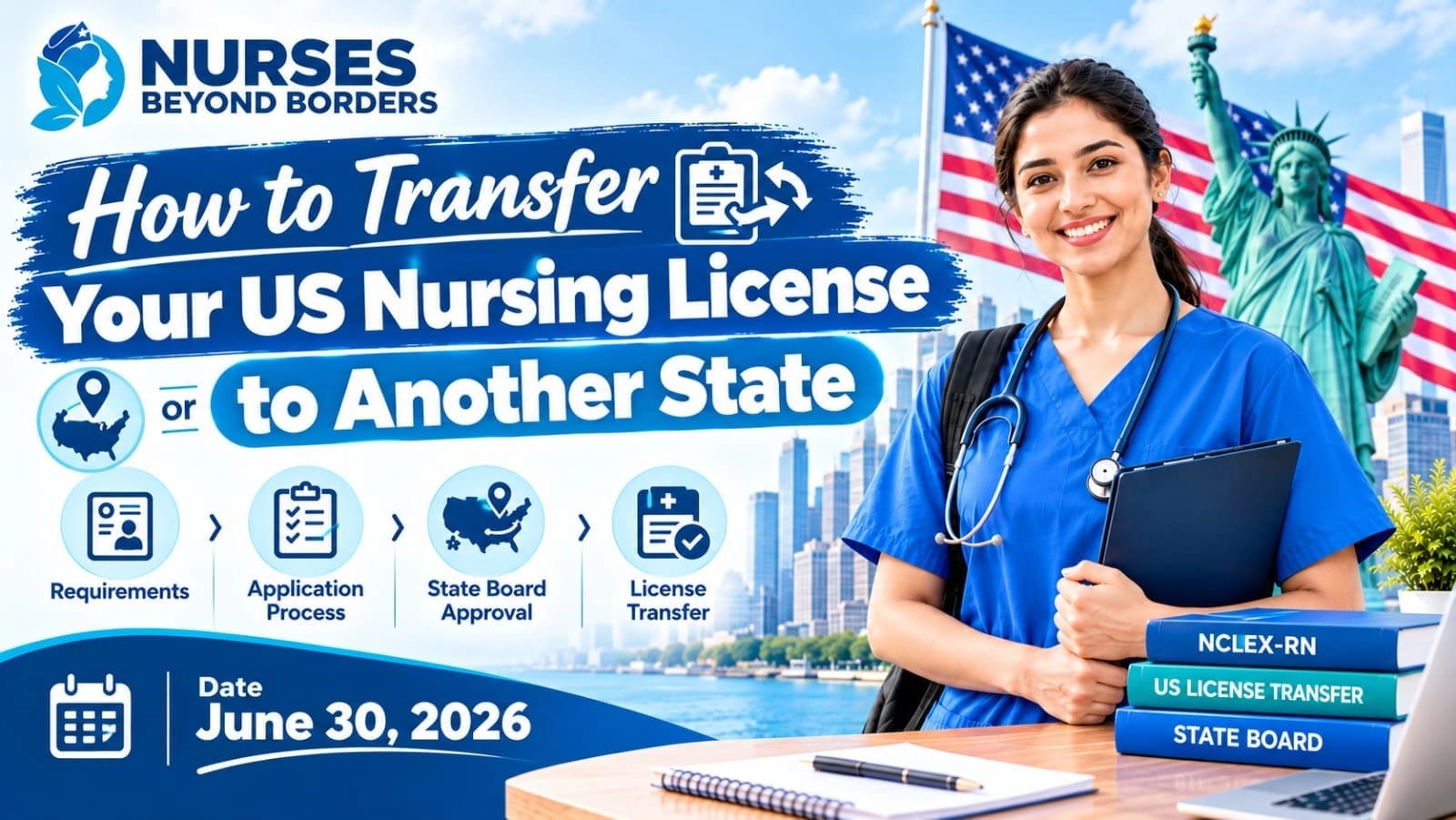
A Complete Guide to License Endorsement for Internationally Educated Nurses Already Working in America
You have already overcome the biggest hurdles. You passed the NCLEX. You completed your CGFNS evaluation, met English language requirements, secured your visa, and verified your nursing credentials. After all that, you began your career as a registered nurse in the United States.
Now you’re planning your next move. Perhaps you’ve accepted a better-paying position in Texas. Maybe your family has relocated to New York. Or you’ve received an exciting opportunity from a healthcare facility in California.
The best part? You do not need to take the NCLEX again.
When you already hold an active nursing license in one U.S. state and want to work in another, the process is called license endorsement. Compared to your original licensing journey, endorsement is much quicker and easier. However, every state has its own licensing requirements, documentation, and procedures that can delay your application if you are not properly prepared.
This guide explains everything you need to know before transferring your nursing license.
What Is License Endorsement?
License endorsement allows a nurse who already holds an active nursing license in one U.S. state to receive authorization to practice in another state without retaking the NCLEX examination. Instead of completing the licensing process again, the new state’s Board of Nursing (BON) reviews your education, examination history, professional credentials, and current license before issuing a new state license.
Think of endorsement as transferring your professional qualifications rather than beginning your nursing career from scratch. Your NCLEX results, educational credentials, and clinical qualifications remain valid. The receiving Board of Nursing simply verifies that you meet its licensing standards.
This differs from initial licensure, which is intended for nurses applying for their first U.S. nursing license. If you already possess an active RN or LPN/LVN license in any state, endorsement is the appropriate pathway.
The License Endorsement Process
Although every state’s Board of Nursing has unique licensing rules, the overall endorsement process follows a similar sequence across the United States.
Step 1: Apply Through the New State’s Board of Nursing
Begin by completing a licensure-by-endorsement application with the Board of Nursing where you plan to work. Most states provide secure online application systems where you’ll submit personal information, nursing credentials, employment details, and the required application fee.
Application fees generally range between $100 and $350, although some states, including California, may cost closer to $500 once fingerprinting and additional processing fees are included.
Step 2: Verify Your Current Nursing License
Your new Board of Nursing must confirm that your existing nursing license is active, unrestricted, and in good standing.
Most states use Nursys, the electronic nurse license verification system managed by the National Council of State Boards of Nursing (NCSBN). If your original licensing state participates in Nursys, verification can usually be requested online for approximately $30.
If your original state is not part of Nursys, you’ll need to request official license verification directly from that Board of Nursing, which must be sent to your new state.
Important: Nursys verifications remain valid for only 90 days, so avoid requesting them too early.
Step 3: Complete Your Background Check
Nearly every state requires fingerprint-based criminal background screening before approving an endorsement application.
Depending on your destination state, you’ll complete either Live Scan digital fingerprinting or submit an FD-258 fingerprint card. Some Boards of Nursing also require separate state and FBI criminal background checks.
If fingerprint cards are mailed from outside the state, processing may take an additional four to six weeks.
Step 4: Submit Official Nursing School Transcripts
Some Boards of Nursing request official nursing transcripts directly from your educational institution.
For internationally educated nurses, obtaining transcripts from overseas nursing schools may require additional coordination. Since many institutions require four to six weeks to process transcript requests, it’s best to begin this step as early as possible.
Step 5: Complete State-Specific Requirements
Every state establishes its own endorsement requirements beyond the standard application process. Depending on where you’re relocating, you may also need to provide additional documentation or complete specific licensing requirements.
- Continuing Education (CE): Some states require proof of recently completed continuing education credits. California, for example, requires licensed nurses to complete 30 CE hours every two years.
- Recent Nursing Practice: Certain Boards of Nursing require documentation showing you’ve actively practiced nursing within the previous two to five years.
- State-Mandated Courses: States such as California and New York require approved coursework covering subjects like infection prevention, child abuse reporting, or state nursing laws before licensure can be issued.
- Credential Evaluation for International Nurses: Some states request a new credential evaluation for internationally educated nurses, even if one was completed during your original licensure process. As a CGFNS-authorized consultancy, Nurses Beyond Borders regularly assists nurses with these additional evaluation requirements.
The Nurse Licensure Compact: Is License Endorsement Always Necessary?
Before beginning your license endorsement application, it is important to determine whether the Nurse Licensure Compact (NLC) applies to your circumstances.
As of 2026, 43 U.S. jurisdictions have adopted the Enhanced Nurse Licensure Compact (eNLC). Nurses who hold a valid multistate license and maintain legal residency in a compact state can practice in any participating compact state without submitting additional endorsement applications, paying extra licensing fees, or waiting for another state license to be issued.
However, several large states, including California, Illinois, and a handful of others, have not fully joined the compact. If you plan to work in one of these non-compact states, you must complete the standard license endorsement process before practicing.
For internationally educated nurses, one additional requirement deserves attention. To qualify for a multistate compact license, applicants must satisfy all 11 Uniform Licensure Requirements (ULRs) established by the eNLC. These include maintaining an unrestricted nursing license, possessing a valid Social Security Number, successfully completing a federal criminal background check, and meeting every other compact eligibility requirement. Nurses who already qualify and legally reside in a compact state can benefit from greater career flexibility while reducing future licensing costs and processing time.
Special Considerations for Internationally Educated Nurses
If you first became licensed in the United States as an internationally educated nurse (IEN), transferring your license to another state may involve additional documentation beyond the standard endorsement process. Based on guidance from the NCSBN Internationally Educated Nurse Resource Manual and our experience supporting hundreds of Pakistani nurses, there are several important factors to consider before applying.
Credential Evaluation May Be Requested Again
Some Boards of Nursing require internationally educated nurses to submit a new credentials evaluation, even if one was previously completed for another state’s licensure. This evaluation confirms that your nursing education is substantially equivalent to a U.S. nursing program. Organizations such as CGFNS review your academic coursework, classroom instruction, clinical experience, and nursing curriculum before issuing their evaluation report.
English Language Verification
Certain states may request verification of English language proficiency through examinations such as IELTS or TOEFL, especially if your nursing education was completed in a language other than English. Nurses who graduated from English-language nursing programs in countries where English is the primary language of instruction, including textbooks and clinical education, are generally exempt from this requirement.
Social Security Number Requirements
Many Boards of Nursing require applicants to provide a valid Social Security Number (SSN) before issuing a nursing license. If you have recently changed your immigration status or are transitioning between visa categories, make sure your SSN records are current before submitting your endorsement application. While a small number of states may accept an Individual Taxpayer Identification Number (ITIN) or provide alternative procedures, licensing policies differ considerably from one state to another.
Verification of Your Home Country License
Certain Boards of Nursing may also request verification of your original nursing license from your home country, even if you have already practiced in the United States for several years. Keeping your Pakistan Nursing Council (PNC) registration details and supporting documents readily available can help prevent unnecessary delays during the endorsement process.
Timeline and Costs: What Should You Expect?
License endorsement processing times vary from one state to another. Some states, including Texas and Florida, often complete applications within two to four weeks, while others, such as California and New York, may require eight to eighteen weeks, depending on application volume, document verification, and processing backlogs.
Overall endorsement expenses—including application fees, fingerprinting, license verification, transcript requests, and any required continuing education courses—generally range between $250 and $600, depending on the destination state.
The most common reason applications are delayed is incomplete documentation. Missing transcripts, expired Nursys verifications, or rejected fingerprint submissions—which occur in approximately 3% of applications—can easily add several weeks to the overall timeline. Preparing every required document before applying remains the best way to avoid unnecessary delays.
Common Mistakes to Avoid
- Requesting Nursys verification too early. License verification remains valid for only 90 days, so request it when you are ready to submit your endorsement application.
- Assuming every Board of Nursing follows identical rules. Each state establishes its own licensing requirements. Always review the latest endorsement instructions published by the specific Board of Nursing.
- Overlooking mandatory state courses. States such as California and New York require approved training in areas like infection control, child abuse reporting, or domestic violence awareness. These courses are simple to complete but frequently forgotten.
- Waiting too long to request official transcripts. Many nursing schools—particularly international institutions—need four to six weeks or longer to prepare academic records. Begin this process as soon as you decide to transfer your license.
- Starting work before receiving your new license. Several states, including California, do not issue temporary endorsement permits. You must wait until your full nursing license has been officially approved before beginning employment.
A Quick Overview of License Endorsement in Popular States
Many internationally educated nurses choose to relocate after gaining experience in the United States. Based on where many of our Nurses Beyond Borders community members live and work, below is a general comparison of endorsement requirements in several of the most popular destination states.
| State | Approx. Fee | Typical Timeline | Key Requirements |
| Texas | $186 | 2–4 weeks | Compact state; Nursys license verification |
| California | $400–500 | 8–14 weeks | Non-compact; California-specific CE requirements |
| New York | $143 | 6–12 weeks | Mandatory child abuse and infection control courses |
| Florida | $200–275 | 2–4 weeks | Compact state; fingerprint-based background screening |
| Illinois | $50–75 | 4–8 weeks | Non-compact; recent nursing practice verification |
Application fees, processing times, and licensing requirements are estimates only and may change without notice. Always review the latest information published by your destination state’s Board of Nursing before applying.
Planning to Transfer Your Nursing License? We’re Here to Help.
At Nurses Beyond Borders, our support doesn’t end once you arrive in the United States. Our mission is to help internationally educated nurses continue building successful nursing careers throughout their professional journey.
If you’re currently working in the U.S. and preparing to transfer your nursing license to another state, our experienced team can guide you through every stage of the endorsement process. From completing applications and coordinating with Boards of Nursing to managing credential verification and required documentation, we help ensure your application is accurate, complete, and submitted on time.
You’ve already overcome the most challenging part of becoming a nurse in America. Let us help make your next move as smooth as possible.
Visit nursesbeyondborders.org or contact our team today to learn more about our Nursing License Endorsement Support Services.
We tell you, honestly.
Final Thoughts
At first glance, license endorsement may seem overwhelming, but the process becomes much easier once you understand the individual requirements. Careful planning is the key to avoiding delays. Research your destination state’s licensing rules, prepare your documentation early, and submit a complete application to prevent unnecessary setbacks caused by missing paperwork or expired verifications.
Most importantly, remember that skilled nurses remain in high demand across the United States. License endorsement exists to help qualified professionals continue serving patients wherever opportunities arise. You’ve already achieved one of the biggest milestones in your nursing career. This is simply the next step toward new opportunities and continued professional growth.
Sources and References
- National Council of State Boards of Nursing (NCSBN) — Licensure of Internationally Educated Nurses: A Resource Manual (2023 Edition)
- Nurse Licensure Compact (eNLC)
- Nursys® Nurse License Verification System
- State Boards of Nursing including California BRN, Texas BON, New York State Education Department (NYSED), and Florida Department of Health
- Rasmussen University, NursingLicensure.org, and Nurse.org (2026 Nurse Licensure Compact updates)