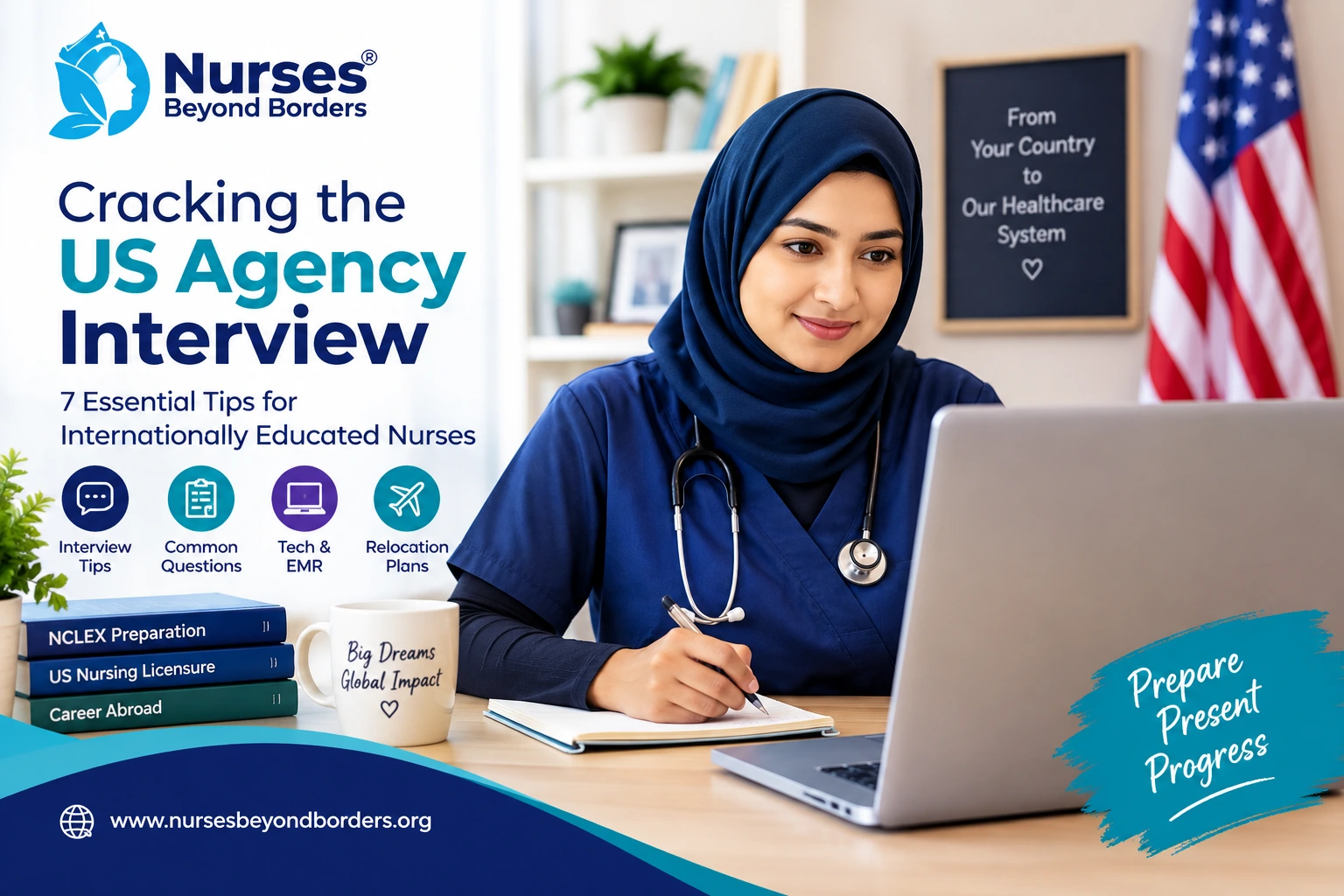
Cracking the US Agency Interview: 7 Essential Tips for International Nurses
Passing the NCLEX is a major milestone on your path to a nursing career in the United States. But preparing for your next step also means getting ready to discuss your clinical experience, professional goals, and expectations with a US nursing recruitment agency.
If you have received an interview invitation, you may be wondering what recruiters will ask, how to explain your nursing background, or how to present yourself confidently when English is not your first language.
The good news is that you can prepare for these conversations.
A US nursing agency interview is an opportunity to demonstrate your professional experience, communication skills, clinical judgment, and commitment to your career goals. Recruiters may also want to understand your familiarity with electronic medical records, your preferred specialty, and your readiness for a potential relocation.
This guide explains seven practical ways to prepare for your US nursing agency interview, along with common questions, preparation tips, and questions you should ask the recruiter. If you are planning to pursue a nursing career in the United States, explore our USRN journey for Pakistani nurses guide to better understand the process and the steps involved.
What Should You Expect During a US Nursing Agency Interview?
A nursing agency interview is not necessarily the same as a clinical examination. Although some interviews include clinical or scenario-based questions, recruiters may also focus on your professional background, communication, career plans, and suitability for available opportunities.
Depending on the agency and recruitment stage, you may discuss:
- Your nursing education and clinical experience.
- Your specialty and the types of patients you have cared for.
- Your NCLEX and licensing status.
- Your experience with electronic medical records and hospital technology.
- Your English communication skills.
- Your career goals and relocation plans.
- Your expectations regarding employment terms and placement opportunities.
Every agency has its own recruitment process, so the questions and requirements can vary.
The best preparation is to understand your own professional background, review the opportunity carefully, and practise explaining your experience with clear, honest answers.
1. Prepare a Strong Introduction That Highlights Your Nursing Experience
One of the most common nursing interview questions is, “Tell me about yourself.”
Your answer helps the interviewer understand your professional background and gives you an opportunity to highlight your most relevant experience.
Instead of describing your entire life story, focus on the information that matters to the position.
Include these five points:
- Your nursing degree and educational background.
- Your internship or clinical training.
- Your current or most recent nursing position.
- Your specialty, responsibilities, and years of experience.
- Your motivation for pursuing a nursing career in the United States.
Example: Introducing Yourself in a Nursing Agency Interview
“Hello, thank you for giving me this opportunity. I am a registered nurse with experience in [your specialty]. I completed my nursing education at [institution name] and gained clinical experience at [hospital name]. My responsibilities have included [relevant responsibilities]. I am interested in pursuing nursing opportunities in the United States because I want to continue developing my professional skills and contribute my experience in a new healthcare environment.”
Adapt this example to your actual qualifications and circumstances. Never include experience or credentials you do not have.
Pro tip: If you have worked in a tertiary-care hospital, a JCI-accredited facility, or a large hospital, mention it when relevant. Explain what you learned or the responsibilities you handled rather than relying on the hospital’s reputation alone.
Practice your introduction until you can deliver it naturally in approximately one to two minutes.
2. Explain Your Nursing Experience Honestly and Clearly
Recruiters may ask how long you have worked as a nurse, whether you are currently employed, and which clinical responsibilities you have handled.
Some agencies seek nurses with at least two years of experience, but eligibility requirements differ by employer, role, and recruitment pathway. Check the specific criteria before applying.
If you have an employment gap, prepare a short and truthful explanation. You may have taken time off for family responsibilities, further education, licensing examinations, or other personal circumstances.
For example:
“After my previous position, I took time to prepare for my licensing examination. During that period, I focused on my professional development, and I am now preparing for the next stage of my nursing career.”
Use this answer only if it accurately describes your situation.
How to Discuss Your Clinical Experience
Rather than simply stating that you have several years of experience, explain the work you performed.
Be ready to discuss:
- The department or specialty where you worked.
- Your usual clinical responsibilities.
- The types of patients you cared for.
- Your role in teamwork and patient communication.
- A challenging situation you handled professionally.
Important: Never fabricate an experience letter, employment history, or qualification. Misrepresentation can damage your professional credibility and create serious problems during recruitment or credential verification.
Recruiters need an accurate understanding of your background to assess whether an opportunity is appropriate for you.
3. Demonstrate Your Familiarity With Electronic Medical Records
Healthcare technology is another subject that may arise during a US nursing agency interview.
Recruiters may ask whether your hospital used electronic medical records (EMRs), electronic health records (EHRs), or other digital clinical systems.
They may want to understand which technologies you have used and how comfortable you are learning new systems.
Prepare to describe your actual experience with:
- Electronic patient documentation.
- Digital medication administration records.
- Laboratory results and diagnostic reports.
- Electronic clinical reporting systems.
- Other software used in your department.
For example, if you used a digital patient documentation system, explain what information you entered, how you accessed patient records, and which responsibilities you performed within that system.
Avoid giving a vague answer such as “Yes, I know computers.” Specific examples provide a clearer picture of your experience.
What if your hospital relied mainly on paper records?
Be honest. Explain the documentation methods you used and demonstrate your willingness to learn unfamiliar technology.
You do not need to claim experience with every US hospital system. Focus on your actual skills, adaptability, and readiness to learn.
4. Practise Common Nursing Interview and Scenario-Based Questions
Behavioural and situational questions help interviewers understand how you approach professional challenges.
These questions often require more than a definition or a textbook answer. The interviewer may want to hear how you assessed a situation, communicated with others, and decided what to do.
Here are examples worth practising.
| Common question | What the interviewer may assess |
| What are your greatest strengths and weaknesses? | Self-awareness and professional development |
| Tell me about a challenging patient-care situation. | Clinical judgment and problem-solving |
| How would you handle a disagreement with a colleague? | Communication and teamwork |
| How would you respond to an upset physician or colleague? | Professionalism and conflict management |
| How do you prioritize multiple patient-care responsibilities? | Organization and clinical judgment |
| Tell me about a time you made a difficult decision. | Decision-making and accountability |
Use the STAR Method to Structure Your Answers
A useful way to organize behavioral interview answers is the STAR method:
- Situation: Describe the circumstances.
- Task: Explain your responsibility.
- Action: Describe the steps you took.
- Result: Explain the outcome and what you learned.
For example, if asked about a disagreement with a colleague, describe a real situation in which you communicated respectfully, followed appropriate clinical procedures, and worked toward a safe resolution.
Always protect patient confidentiality when discussing clinical experiences.
Prepare three to five genuine examples from your nursing career. Choose examples that demonstrate teamwork, patient safety, communication, prioritization, and your ability to learn from challenging situations. You can also review our NCLEX-RN preparation guide to strengthen your understanding of clinical concepts relevant to your nursing journey.
Do not memorize complete answers word for word. Understand the key points so you can respond naturally to different questions.
5. Improve Your English Communication and Listening Skills
Clear communication is essential during a nursing interview. You need to understand questions, explain your experience, and communicate your professional judgment effectively.
If you are unfamiliar with an American accent, listening practice can help you become more comfortable before the interview.
Try these activities in the days leading up to your interview:
- Practice speaking English with a friend or family member.
- Arrange mock interviews with other nurses.
- Listen to American English podcasts or healthcare-related videos.
- Record yourself answering common interview questions.
- Review your recordings to identify unclear sentences or unnecessary pauses.
- Practice explaining clinical situations in simple, organized language.
You do not need an American accent to communicate effectively. Focus on clarity, appropriate professional language, and understanding the interviewer’s questions.
If you do not understand something, ask politely:
“Could you please repeat or clarify the question? I want to make sure I understand it correctly.”
This is better than guessing what the interviewer means.
If you need formal English-language preparation, research the requirements relevant to your licensing or immigration pathway. To understand the differences between these tests, read our IELTS vs OET guide for Pakistani nurses.
IELTS or another English-language assessment may be relevant in some circumstances, but requirements vary. Do not assume that every nursing agency requires the same examination or score.
6. Focus on Your Professional Readiness, Not Just Your Academic Marks
Some nurses worry that their CGPA or academic marks will determine the outcome of their agency interview.
Although educational qualifications and transcripts can be important for eligibility, credential evaluation, or licensing, interviewers may also be interested in your practical experience, communication, professional judgment, and career goals.
Prepare to explain how your education and clinical experience have helped you develop as a nurse.
Review the qualifications listed in your application and make sure you can discuss them accurately.
During interview preparation, prioritize:
- Your clinical experience and responsibilities.
- Your knowledge of your specialty.
- Your professional strengths.
- Your ability to work with a healthcare team.
- Your willingness to learn and adapt.
- Your reasons for pursuing a US nursing opportunity.
Do not ignore your academic records. Instead, prepare for questions about them and devote sufficient practice time to explaining your real-world experience.
Remember that hiring decisions vary between agencies and healthcare employers. No single interview factor guarantees an offer.
7. Prepare for Questions About Family, Relocation, and Employment Terms
Your potential relocation to the United States may affect your family and long-term plans. Depending on the agency and recruitment pathway, the recruiter may ask about your availability, relocation preferences, family arrangements, or sponsorship needs. You can also read our guide to the EB-3 visa for nurses to learn more about one potential employment-based immigration pathway.
Consider how you will answer questions such as:
- Why do you want to work in the United States?
- Are you prepared to relocate if selected?
- What is your current licensing or credentialing status?
- Will you require employment-based immigration sponsorship?
- What are your family or relocation plans, if relevant?
Answer honestly and avoid promising something you cannot confirm.
It is also important to understand that an agency interview is a two-way conversation. You are assessing the agency just as it is assessing your suitability for an opportunity.
Questions You Should Ask the Nursing Agency
Before agreeing to a recruitment arrangement, consider asking:
- What are the next steps in the recruitment process?
- Which employers or healthcare facilities may be involved?
- What are the eligibility requirements for the opportunity?
- What support, if any, is available for licensing or credentialing?
- What are the employment contract terms and expected working hours?
- Which costs, fees, or financial obligations may apply?
- What happens if the proposed placement changes or does not proceed?
- Who can explain the immigration process and related obligations?
Request written information about important contractual commitments. If you are uncertain about legal, employment, or immigration terms, consult an appropriately qualified professional before signing.
A clear understanding of the process can help you make informed decisions about your career.
US Nursing Agency Interview Checklist
Use this checklist the day before your interview.
- Practice your introduction.
- Review your nursing resume and application details.
- Prepare an honest explanation for any employment gaps.
- Review your clinical experience and specialty.
- Prepare examples involving teamwork, patient care, and problem-solving.
- Practice listening to and answering questions in English.
- Review your licensing and credentialing status.
- Prepare questions about the agency and employment terms.
- Test your internet connection, microphone, and camera if the interview is online.
- Keep your resume, relevant documents, pen, and notes ready.
- Confirm the interview time and time zone.
- Choose a quiet location where you can speak without interruptions.
Preparation does not remove every uncertainty, but it can help you approach the conversation in a more organized and confident way.
Frequently Asked Questions About US Nursing Agency Interviews
What questions are asked in a US nursing agency interview?
Questions vary by agency and recruitment stage. Common topics include your nursing background, clinical specialty, professional strengths, challenging patient-care situations, communication skills, technology experience, licensing status, and motivation for working in the United States.
Is passing the NCLEX enough to secure a nursing job in the USA?
No. Passing the NCLEX is an important milestone, but it does not by itself guarantee employment, state licensure, immigration approval, or placement. Additional requirements depend on the relevant state board, employer, credentialing process, and immigration pathway.
How should I introduce myself in a nursing interview?
Start with your nursing education, relevant clinical experience, specialty, current or previous position, and professional goals. Keep the introduction concise and use specific information that accurately reflects your background.
What should I do if I do not understand an interview question?
Politely ask the interviewer to repeat or clarify the question. Take a moment to understand what is being asked before answering. Clear communication is more important than rushing to respond.
What should I ask a US nursing recruitment agency before signing a contract?
Ask about the recruitment process, potential placement, contract duration, working hours, fees or financial obligations, licensing support, and what happens if circumstances change. Review all written terms carefully and seek qualified advice when necessary.
Can Nurses Beyond Borders help me prepare for my US nursing journey?
Nurses Beyond Borders presents itself as a consultancy supporting internationally educated nurses pursuing US placement opportunities. Contact the organization directly to confirm its current services, eligibility criteria, and the support available for your individual circumstances.
Take the Next Step Toward Your US Nursing Career
Preparing for a US nursing agency interview involves more than memorizing answers. You need to understand your professional strengths, communicate your experience clearly, and know what to ask before committing to an opportunity.
By preparing your introduction, practising realistic scenarios, reviewing your technology experience, and understanding your relocation and employment plans, you can approach the interview with greater clarity.
You do not have to navigate every stage of your journey without guidance. The right support can help you understand the process, identify your next steps, and make more informed decisions.
Ready to explore your US nursing journey?
Contact Nurses Beyond Borders to learn about the guidance and services available to internationally educated nurses pursuing US placement opportunities.
Book a Free Call with Nurses Beyond Borders
Discuss your current situation, ask questions about the process, and find out whether the available support is suitable for your goals.
Your nursing experience matters. Prepare carefully, ask informed questions, and take your next step with confidence.