Can International Nurses Apply for RN License Endorsement?
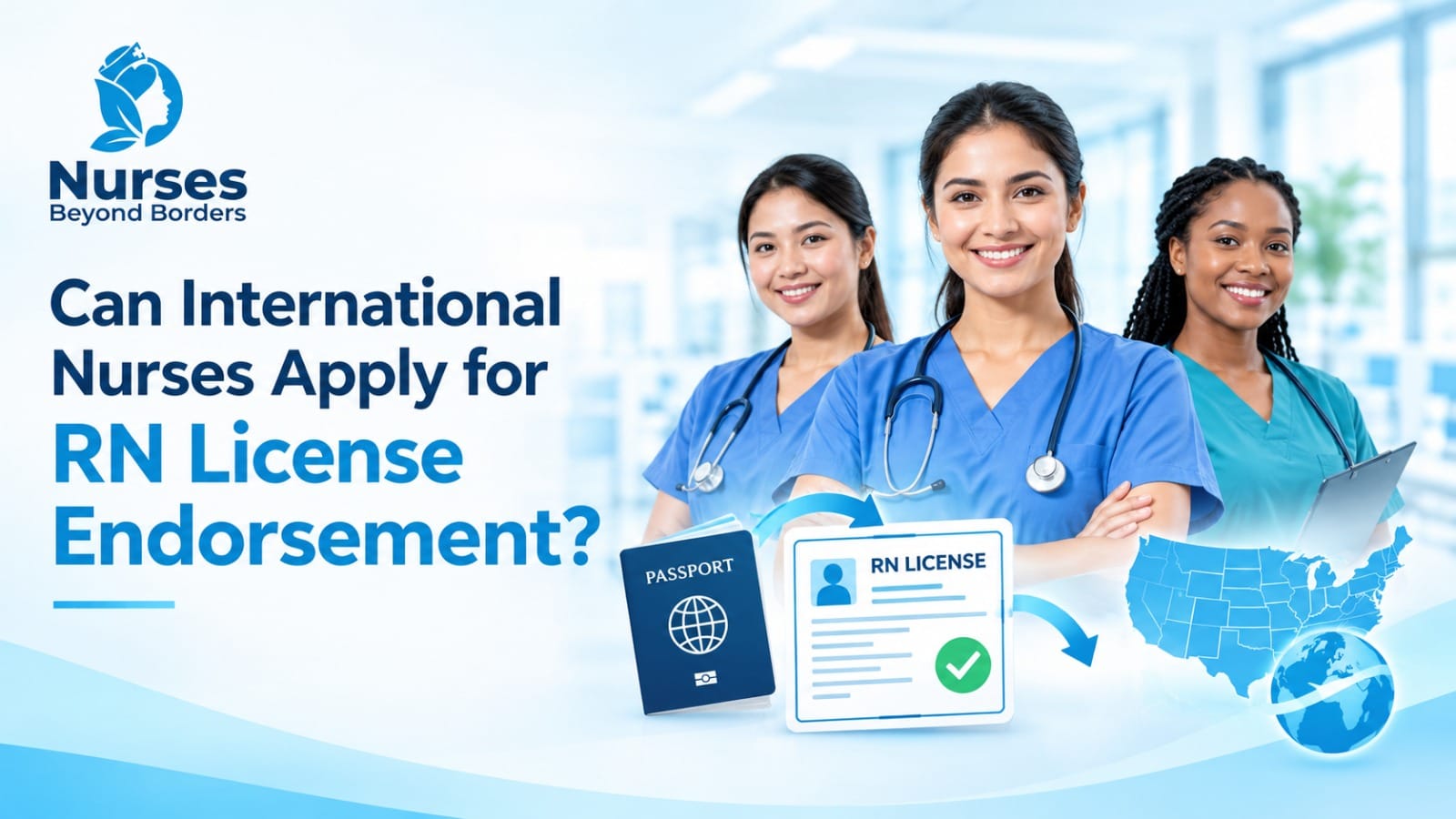
If you are an internationally educated nurse wondering, “Can international nurses apply for RN endorsement?”, the answer is yes—but there is one important requirement: you generally need to already hold a U.S. RN license before applying for licensure by endorsement in another state.
RN endorsement is different from getting your first U.S. nursing license. If you are a foreign-trained nurse who has already passed the NCLEX-RN and obtained a U.S. RN license, endorsement may allow you to apply for another state’s RN license without repeating the entire initial licensure process.
However, nursing license requirements are determined by individual state boards, so the exact documents, fees, verification requirements, and eligibility criteria can vary. The National Council of State Boards of Nursing (NCSBN) specifically directs nurses to check requirements based on the state where they plan to practice.
The Short Answer: Can International Nurses Apply for RN Endorsement?
Yes, international nurses can apply for RN license endorsement if they already have a qualifying U.S. RN license and meet the requirements of the state where they want to become licensed.
For example, imagine you are a nurse educated in Pakistan. You completed the required credentialing process, passed the NCLEX-RN, and obtained an RN license in one U.S. state.
Later, you decide to work in another state.
Instead of starting your U.S. nursing journey from the beginning, you may be able to apply for licensure by endorsement.
This is why the difference between initial licensure and endorsement is so important:
- Initial licensure: Getting your first U.S. nursing license.
- Endorsement: Applying for a nursing license in another state based on an existing U.S. nursing license.
NCSBN confirms that U.S. nursing licensure is state-based and that requirements can vary between jurisdictions.
What Do You Need Before You’re Eligible for Endorsement?
If you are researching foreign-trained RN endorsement eligibility, start with your current U.S. license.
1. An Active U.S. RN License
The most important question is whether you already hold a U.S. RN license.
If you have an active U.S. RN license and want to practice in another state, you may be eligible to apply for endorsement.
Your international nursing education does not automatically prevent you from applying. In fact, NCSBN provides separate guidance for internationally educated nurses because state requirements can differ depending on education and licensing circumstances.
For example:
Pakistani nurse → NCLEX-RN → U.S. RN license → another state’s RN license through endorsement
The important point is that endorsement comes after initial U.S. licensure.
2. Your License Should Be in Good Standing
Another important consideration is the status of your existing RN license.
If your license has unresolved disciplinary matters, restrictions, or other issues, the target state’s nursing board may require additional information or review.
Before beginning an internationally educated nurse license transfer, check:
- Current RN license status
- Expiration date
- Disciplinary history
- Any restrictions or encumbrances
- License verification requirements
- Additional requirements of the destination state
Never assume that one state’s requirements automatically apply to another state.
How Is Endorsement Different From Your Original NCLEX and Licensure Process?
Many international nurses confuse endorsement with their original U.S. licensing process.
When you first pursue U.S. licensure as an internationally educated nurse, you may need to deal with credential evaluation, education verification, English-language requirements where applicable, NCLEX-RN registration, examination, background checks, and state-specific requirements.
NCSBN states that all U.S. boards use the NCLEX-RN for RN licensure and that requirements for internationally educated nurses vary by state.
Endorsement is different.
You have already completed the initial licensing journey and obtained a U.S. RN license. Now, you are applying for authorization to practice in another jurisdiction.
That means you should not automatically repeat every step you completed for your first U.S. license.
Instead, review the destination state’s endorsement requirements carefully.
What If You Haven’t Gotten Your First U.S. RN License Yet?
If you are an internationally educated nurse who has not yet obtained a U.S. RN license, endorsement is generally not the pathway you should start with.
You may first need to complete the initial U.S. licensure process.
Depending on your state and circumstances, this can involve:
- Selecting a state for initial licensure.
- Reviewing the state’s requirements for internationally educated nurses.
- Completing credential evaluation or verification if required.
- Meeting applicable English-language requirements.
- Registering for the NCLEX-RN.
- Passing the NCLEX-RN.
- Completing remaining state requirements.
- Receiving your first U.S. RN license.
NCSBN’s international nurse guidance allows applicants to review requirements according to their education location and intended state of practice.
If you are still preparing for NCLEX-RN, explore NCLEX Services instead of starting with endorsement.
You can also connect this article to your main U.S. Nursing License Process pillar article so readers can understand the complete pathway from international nursing education to U.S. RN licensure.
Does Your Country of Nursing Education Affect Endorsement Eligibility?
Your country of nursing education does not automatically disqualify you from RN endorsement.
This is one of the biggest concerns among internationally educated nurses.
A nurse educated in:
- Pakistan
- India
- The Philippines
- Nigeria
- Ghana
- Nepal
- Kenya
- The Middle East
- Or another country
may potentially pursue endorsement after obtaining an eligible U.S. RN license.
However, your international education can still matter when a board reviews your licensing history and supporting documentation.
NCSBN emphasizes that requirements for internationally educated nurses vary by state.
Credential organizations such as CGFNS/TruMerit also provide credential verification and evaluation services for internationally educated healthcare professionals, including verification of identity, academic records, licensure, employment, and English proficiency where applicable.
So the better question is not:
“Does my country prevent me from endorsement?”
Instead, ask:
“Do I have a U.S. RN license, and what does my target state’s board require from me?”
What Can Make RN Endorsement More Complicated for International Nurses?
Although the endorsement pathway is not automatically harder simply because you were educated outside the U.S., IENs can encounter documentation issues.
Name and Document Mismatches
Your name may appear differently on your:
- Passport
- Nursing license
- Nursing diploma
- Transcript
- Credential evaluation
- U.S. RN license
- Other identification documents
For example, a married name, maiden name, spelling variation, or different name order can create additional verification questions.
Before applying, review your documents carefully and prepare legal name-change documentation if applicable.
Older Credential Evaluation Reports
International nurses sometimes have credential evaluations from the initial U.S. licensing process.
However, you should not automatically assume that an older report will satisfy the current requirements of a different state.
Credential evaluation requirements can vary depending on the board and purpose. CGFNS/TruMerit provides credential evaluation and verification services for internationally educated professionals, so nurses should confirm exactly what their target board requires before ordering or submitting documents.
This is especially important if your original credential evaluation was completed several years ago.
Internationally Educated Nurse License Transfer: What Should You Check?
Before applying, create a simple checklist.
Check your:
- U.S. RN license status
- License expiration date
- License verification
- Target state’s endorsement requirements
- Background-check requirements
- Identification documents
- Name consistency
- Credential evaluation requirements
- Application fees
- Additional state-specific documentation
The NCSBN licensure guidance tool is useful for identifying state-specific requirements because U.S. nursing regulation is handled at the state level.
How Nurses Beyond Borders Helps International Nurses With Endorsement
If you are an internationally educated nurse who already holds a U.S. RN license, the next step can feel confusing—especially when documentation, verification, and state-specific requirements are involved.
Nurses Beyond Borders helps international nurses navigate the U.S. nursing pathway, including license endorsement and credential-related services.
The organization already provides a dedicated License Endorsement service and resources for internationally educated nurses. Its existing content also explains how nurses can transfer a U.S. nursing license to another state.
If you already have a U.S. RN license and want to practice in another state, explore the License Endorsement service to understand your next steps.
If you have not yet obtained your first U.S. RN license, start with NCLEX Services and your initial U.S. licensure pathway instead.
For nurses who need help understanding international credentials, connect this page with the Credential Evaluation service as well.
Frequently Asked Questions
1. Can international nurses apply for RN endorsement?
Yes. Internationally educated nurses can potentially apply for RN endorsement if they already hold a qualifying U.S. RN license and meet the requirements of the state where they want to practice.
2. Do internationally educated nurses need extra steps for RN license endorsement?
Possibly. Requirements depend on the destination state and the nurse’s individual licensing and education history. Additional verification or documentation may be required.
3. Can I apply for endorsement if I haven’t taken the NCLEX yet?
Usually, endorsement is not the appropriate first step if you do not yet have a U.S. RN license. You generally need to complete the initial U.S. licensure pathway first, which may include the NCLEX-RN.
4. Does my country of nursing education affect my endorsement eligibility?
Your country of education does not automatically prevent endorsement. However, your international education and credentials may be relevant to documentation or verification requirements established by the destination state.
5. Is endorsement harder for foreign-trained nurses than U.S.-trained nurses?
Not necessarily. The process is based on the requirements of the state where you are applying. However, internationally educated nurses may have additional credential or document-verification considerations.
6. What is the first requirement for RN endorsement eligibility?
The first thing to check is whether you already have an eligible U.S. RN license. After that, review the endorsement requirements of the state where you want to practice.
Final Takeaway
So, can international nurses apply for RN endorsement? Yes.
If you are a foreign-trained or internationally educated nurse who already holds a U.S. RN license, you may be able to obtain another state’s RN license through endorsement.
The most important thing is to understand that endorsement is not the same as initial U.S. licensure.
If you have not yet obtained your first U.S. RN license, focus on the NCLEX and initial licensing pathway. If you already have a U.S. RN license, review the requirements of your target state and prepare your verification and supporting documents carefully.