If you are a Pakistani nurse working in Kuwait and considering a move to the United States, this guide explains the full USRN pathway in the correct order — including CGFNS credential evaluation, NCLEX registration, IELTS/OET requirements, VisaScreen, and the EB-3 Green Card process.
The question most Pakistani nurses in Kuwait are asking right now
You did not come to Kuwait by accident.
For many nurses, the decision was practical — tax-free income, better working conditions, and stronger clinical exposure in a structured hospital system. For others, it was always part of a longer plan: Kuwait first, United States next.
If that second category sounds familiar, the question is usually the same:
I already have international experience. I am working in a hospital system. How do I convert this into a pathway to the USA?
This guide answers that question in full — not as a summary, but as a structured roadmap so you understand exactly what comes next and in what order.
Why this moment matters for Pakistani nurses in Kuwait
Timing matters more in the USRN journey than most nurses realize at the beginning.
The demand for registered nurses in the United States continues to rise due to long-term workforce shortages and retirement trends within the healthcare system. At the same time, international nurses are increasingly being recruited to fill structured staffing gaps in hospitals across multiple states.
For Pakistani nurses working in Kuwait, this creates a clear window of opportunity: you already have international clinical exposure, which places you ahead of candidates applying directly from home countries.
But advantage only matters if the process is started correctly and in the right sequence.
The honest Kuwait vs USA comparison
You deserve a straight answer here — not a sales pitch and not an oversimplified “USA is better” narrative.
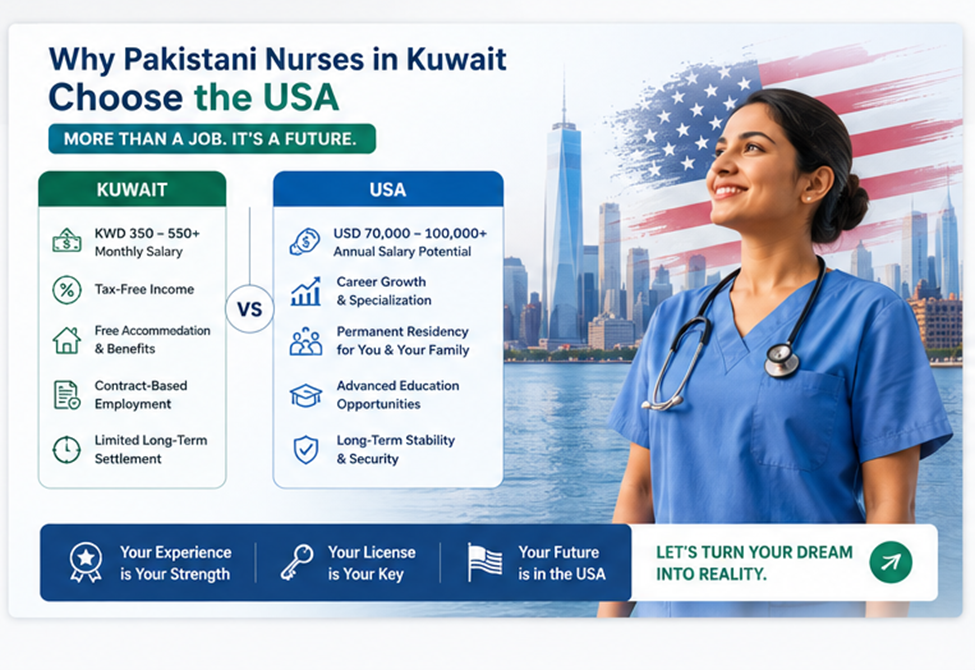
Kuwait offers competitive nursing salaries, typically in the range of KWD 350–550+, along with tax-free income, free accommodation, and structured employment benefits. In many hospitals, the total monthly compensation for a registered nurse averages around KWD 613, which is approximately USD 2,000–2,200 depending on exchange rates. With no income tax and reduced living expenses, this is a stable and meaningful earning position.
That part is real, and it matters.
But there are limits to what Kuwait can offer.
Permanence is one of them. Employment in Kuwait is contract-based and renewable. In practice, that means your residency and income are always tied to employer sponsorship. A policy change, contract non-renewal, or personal circumstance can disrupt everything quickly. You are building stability — but not ownership of long-term settlement.
Career progression is another limitation. While clinical experience in Kuwait is strong and internationally respected, advanced nursing roles, specialist career pathways, and academic progression into higher degrees are significantly more structured and accessible within the US healthcare system.
The final difference is long-term family settlement. The EB-3 pathway to the United States is not just employment-based migration — it is a structured route to permanent residency that extends to your spouse and children. That changes the trajectory from temporary overseas work to long-term settlement.
Kuwait is a strong stepping stone. For many nurses, it is an excellent phase of their career. But it is rarely the final destination when the long-term goal is permanent settlement and career expansion.
The complete USRN process for Pakistani nurses in Kuwait
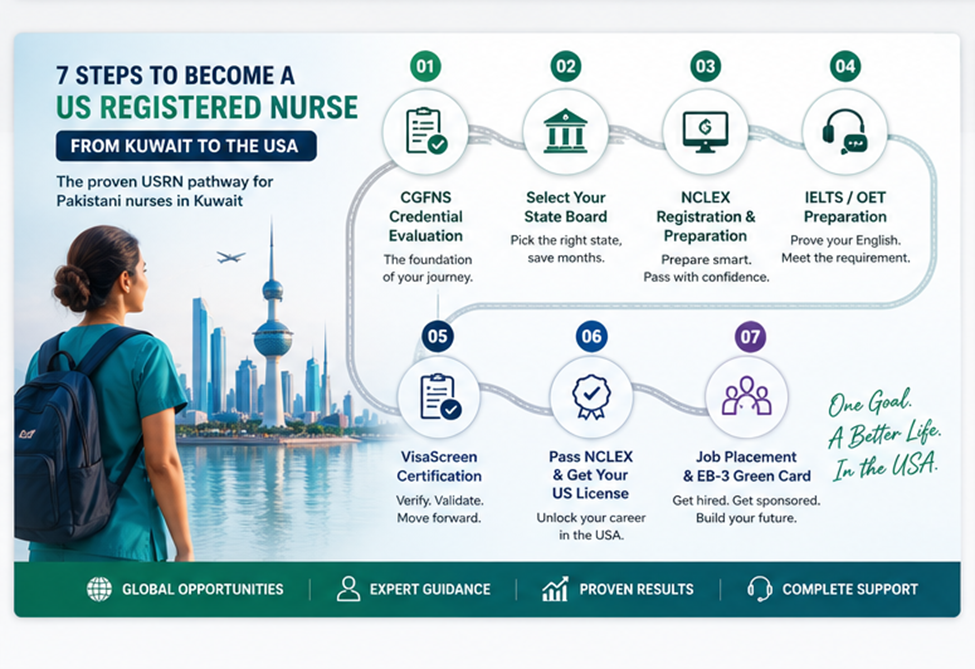
Below is the full pathway — in the correct order. Sequence matters more than speed. Most delays in the USRN journey happen because steps are taken in the wrong order, not because nurses lack ability.
Step 1: CGFNS Credential Evaluation
This is the foundation of the entire USRN pathway. Every other step depends on it being completed correctly.
CGFNS International is the primary body responsible for evaluating internationally educated nurses who want to work in the United States. Their reports are used by state boards, immigration authorities, hospitals, and licensing bodies to confirm that your education and clinical training meet US standards.
Without this step, you cannot meaningfully progress toward NCLEX eligibility or US licensure.
What this step actually involves
Primary source verification
Your nursing college or university in Pakistan is contacted directly to verify your degree, transcripts, and clinical training. This is not document checking — it is institutional verification.
State Board of Nursing application
You must apply to a US state nursing board to begin licensure processing. Each state has its own rules for internationally educated nurses. Choosing the wrong state here can add months of delays later.
CGFNS Certification Program (if required)
Some states require completion of the CGFNS Certification Program before you are allowed to sit the NCLEX-RN exam. Others do not. This difference is critical and must be confirmed before applying, not after.
VisaScreen preparation (parallel process)
VisaScreen is required for US work visa processing. It verifies your credentials, English proficiency, and licensure status. It runs alongside other steps and should not be delayed until the end of the process.
The most important point in this stage
We are an officially authorised CGFNS agent.
This means credential evaluation submissions made through our process are correctly structured, properly filed, and actively tracked through completion. Many nurses lose months by using unauthorised intermediaries who submit incomplete or incorrect applications that do not move forward in the system.
This step determines how fast or slow your entire USRN journey becomes.
If you are a Pakistani nurse in Kuwait considering the USA pathway, the correct starting point is a structured review of your eligibility and state selection — before any documents are submitted.
Step 2: Select your State Board of Nursing
This is one of the most important decisions in the entire USRN pathway because it directly affects your timeline, documentation requirements, and in some cases whether you are required to complete additional steps like the CGFNS Certification Program.
Some US states are more streamlined for internationally educated nurses, including faster processing times, clearer documentation pathways, and stronger experience with foreign nursing qualifications. Others are slower, more complex, or less familiar with Pakistani credentials, which can create unnecessary delays.
The key point is simple: this is not a decision to make based on a blog, a Facebook group, or a YouTube video. Each state has its own rules, and those rules change regularly.
This decision should only be made after a proper assessment with someone who actively works with Pakistani nurses and understands how different state boards actually process international applications in practice.
This is typically the first strategic step we cover in a consultation, because everything else depends on it.
Step 3: NCLEX registration and preparation
Once your state board application is submitted and moving forward, NCLEX preparation begins in parallel. You do not wait for everything else to finish before starting — timing matters in this process.
NCLEX-RN is the licensing exam required by all US state boards of nursing. It is a computer-adaptive test, which means each question changes based on your previous answer performance.
This is where many nurses misunderstand the exam.
NCLEX is not a memory-based exam. It is not testing how much content you can recall. It is testing clinical judgment — your ability to prioritize, assess risk, and make safe decisions in real patient scenarios under pressure.
This is also why strong academic performers often struggle, while nurses trained with structured clinical reasoning consistently perform better. The difference is not intelligence — it is method.
In structured preparation environments, NCLEX pass rates can reach significantly higher levels than the global average for internationally educated nurses (around 53%), because the focus shifts from memorization to decision-making frameworks.
NCLEX Mastery Program (how preparation is structured)
The NCLEX Mastery Program is designed around clinical reasoning rather than content repetition. It includes:
- 80+ recorded lectures focused on decision-making, not memorization
- Weekly live Zoom coaching sessions with NCLEX instructors
- Full-length mock exams based on current CAT and Next Generation NCLEX format
- One-on-one performance review and improvement planning
- UWorld strategy training (how to use question banks for reasoning development, not just practice volume)
- A structured roadmap from first study session to exam readiness
For nurses in Kuwait
All NCLEX preparation is fully online and accessible from Kuwait without disruption to work schedules.
Sessions are recorded, and live classes are scheduled across multiple time zones, so shift work does not prevent participation.
The NCLEX exam itself can be taken at approved international test centers. Depending on eligibility and scheduling, nurses may test in nearby Pearson VUE centers or travel options such as the testing facility in Lahore. The most practical route is usually determined case-by-case based on timing and availability.
Step 4: IELTS or OET preparation
English language proficiency is a mandatory requirement for both licensure and VisaScreen certification. The two accepted exams are IELTS and OET.
One of the most common frustrations among nurses in Kuwait is this: they use English daily in clinical environments, yet still struggle to move beyond IELTS band 6.0.
The issue is not English fluency.
It is test alignment.
IELTS is not evaluating general communication ability. It evaluates whether you can produce structured academic responses that match specific marking criteria used by examiners. These structures are predictable, trainable, and highly repeatable when taught correctly.
IELTS Mastery for Nurses (how preparation is structured)
The IELTS Mastery for Nurses program is built specifically for healthcare professionals and includes:
- Nursing-based content instead of generic English exercises
- Detailed human feedback on Task 1 and Task 2 writing (not automated scoring tools)
- Structured speaking practice for all three test parts with performance feedback
- Weekly timed mock exams under real test conditions
- Targeted band improvement strategy (from 6.0 → 6.5 → 7.0 with specific corrections)
Optional OET preparation pathway for healthcare–focused assessment
For nurses in Kuwait
IELTS testing centers are available within Kuwait, allowing candidates to sit and retake exams locally when needed.
The entire preparation program is delivered online and can be adjusted around shift schedules, making it suitable for working hospital environments without disrupting employment commitments.
Step 5: VisaScreen Certification
The VisaScreen Visa Credentials Assessment is a mandatory requirement for any health professional planning to work in the United States as a nurse.
VisaScreen is not optional. Even if you have passed NCLEX and secured a job offer, you cannot legally begin work in the US without a completed VisaScreen certificate. It verifies three core areas: your educational credentials, your English language proficiency, and your professional licensure.
Where nurses in Kuwait lose time is not understanding its timing. VisaScreen is not a “final step” you handle at the end — it is a parallel process that should start early. Nurses who delay it until after receiving a job offer are often forced to postpone their start dates while they wait for documentation that could have already been in progress months earlier.
At Nurses Beyond Borders, VisaScreen is managed in parallel with your entire USRN pathway so that by the time you receive a job offer, you are already close to completion — not starting from zero.
Step 6: Passing NCLEX
You take the exam. You pass. (With 92% of nurses trained through our program achieving this outcome.)
Within 48 hours, your NCLEX result is released through the Quick Results system. Once your state board processes the result, you are officially issued your US nursing license.
This is the point where your profile becomes fully eligible for US employment sponsorship. Your employer sponsor can now begin the formal immigration process, including preparation for your EB-3 petition.
From this stage onward, you move from qualification into placement — where licensing, documentation, and sponsorship come together to transition you into the US healthcare system.
Step 7: Job Placement and EB-3 Green Card
This is where your Kuwait experience becomes a real advantage.
Pakistani nurses working in Kuwait, UAE, or Saudi Arabia bring something highly valued in the US market: proven international clinical experience. You have already worked in structured hospital systems outside Pakistan, adapted to multicultural teams, and delivered patient care under international standards. US employers recognise this immediately.
This experience strengthens your profile in a competitive hiring environment and often improves both interview outcomes and placement speed.
What we support in job placement:
- Direct connections with verified US hospital hiring partners actively recruiting international nurses
- Matching based on your specialty, experience, and long-term goals
- USRN-standard CV restructuring aligned with US recruiter expectations
- End-to-end EB-3 Green Card sponsorship guidance
Understanding the EB-3 Green Card pathway:
The EB-3 visa for registered nurses is an employer-sponsored immigration route. It begins when a US employer files a petition on your behalf, followed by priority date allocation, consular processing, and final visa approval.
This is not a lottery system. It is a structured immigration process built around documented labor shortages in the US healthcare system. Nursing is officially classified as a shortage occupation, which is why this pathway remains one of the most reliable long-term immigration options for Pakistani nurses.
We guide you through every stage — from employer sponsorship and I-140 filing to priority date tracking, embassy interview preparation, and final Green Card issuance.
Why your Kuwait experience is an advantage, not a barrier
Many Pakistani nurses assume Gulf experience may weaken their US application. In reality, it does the opposite.
US hospitals and recruitment agencies place strong value on nurses who have already worked in international healthcare environments. Your experience in Kuwait demonstrates adaptability, clinical competence in a high-demand system, and the ability to function in multicultural, protocol-driven hospital settings.
This is not background information — it is evidence of readiness. Your Gulf experience, combined with your Pakistani qualification and US licensing pathway, creates a stronger profile than domestic experience alone. It shows continuity, mobility, and proven performance under international standards.
The most common mistakes Pakistani
nurses in Kuwait make
After working with hundreds of nurses in this exact situation, the same patterns show up repeatedly. These are not random setbacks — they are predictable process errors that cost time, money, and momentum. Understanding them early is what prevents delays later.
Mistake 1: Starting NCLEX preparation before credential evaluation is in motion
Many nurses jump straight into NCLEX study because it feels productive. The problem is that without credential evaluation underway, you are preparing for an exam you are not yet eligible to register for.
The correct approach is not “either/or” — it is parallel execution. Credential evaluation should begin immediately, and NCLEX methodology should be introduced alongside it so you are not starting from zero later.
Mistake 2: Using an unauthorized CGFNS agent
This is one of the most expensive hidden errors. Some consultancies accept documents and fees but are not recognized as authorized CGFNS agents. The result is delayed or rejected submissions — and months lost before the issue is even understood.
Verification is simple and takes less than a minute. Any legitimate service should be able to confirm authorization. We are an officially authorized CGFNS agent, and submissions handled through us are processed correctly from the start.
Mistake 3: Relying on general English courses for IELTS preparation
Most nurses in Kuwait already use English daily in clinical settings. Yet IELTS scores often stall at band 6.0. The issue is not English ability — it is misaligned preparation.
Generic courses do not teach the specific task structures IELTS examiners score against. Without targeted feedback on writing and speaking performance, progress plateaus regardless of effort.
Mistake 4: Treating VisaScreen as a “later step”
VisaScreen is frequently delayed because nurses assume it belongs at the end of the journey. In reality, it should begin as soon as credential evaluation starts.
Leaving it too late is one of the most common reasons nurses have their job start dates pushed back after passing NCLEX and receiving offers.
Mistake 5: Choosing a state board based on informal advice
State board requirements are not static. They change, and they vary significantly between states. Advice from peers or old experiences often no longer applies.
This decision directly impacts your timeline, documentation requirements, and eligibility pathway — and should be made with current, case-specific guidance, not general opinions.
How Nurses Beyond Borders supports Pakistani nurses in Kuwait
We work with nurses across Kuwait, UAE, Saudi Arabia, and Pakistan every week. The entire USRN pathway — credential evaluation, NCLEX, IELTS, VisaScreen, job placement, and EB-3 guidance — is delivered online and designed to fit around rotating hospital schedules.
You do not need to relocate or resign to begin. The process starts where you are, and each step is built in sequence and in parallel where needed.
What we provide:
- Credential Evaluation: Official CGFNS-authorized submission and end-to-end tracking
- NCLEX Mastery Program: 92% pass rate with structured clinical reasoning training, live coaching, and mock exams
- IELTS Mastery for Nurses: Nurse-specific preparation with real examiner-style feedback on writing and speaking
- VisaScreen: Initiated early and managed in parallel to avoid end-stage delays
- US Job Placement: Verified US hiring partners and CV optimization aligned with nurse recruiter standards
- EB-3 Green Card Guidance: End-to-end support from employer sponsorship to permanent residency
The starting point
Every journey begins the same way: a free 20-minute consultation.
There is no pitch and no obligation. The purpose is clarity — where you are now, what stage your process is in, and what needs to happen next in the correct order.
If you are just starting, we map the full pathway. If you are already underway, we identify gaps, delays, and the fastest route forward from your current position.
Frequently asked questions from Pakistani nurses in Kuwait
Can I start the USRN process while working full-time in Kuwait?
Yes. Most steps run in parallel with your job. Credential evaluation and VisaScreen require minimal ongoing effort, and NCLEX/IELTS preparation is fully flexible and online.
Do I need to resign from my job to start?
No. Most nurses continue working and only consider resignation once their NCLEX eligibility and job offer stage is near completion.
How long does the full process take?
On average, 18–24 months from credential submission to working in a US hospital. Timelines can shorten with properly sequenced parallel processing or extend if steps are delayed or done incorrectly.
Does my Kuwait experience count for the US?
Yes. Gulf clinical experience is valued by US employers and can strengthen both your profile and hiring speed. In some cases, it also supports state board requirements depending on the state selected.
Can I take the NCLEX from Kuwait?
Yes. NCLEX is available in approved international testing centers. We guide nurses on the most practical testing location, including options in nearby regions such as Pakistan.
What happens if my IELTS expires before visa processing is complete?
IELTS validity is two years. Timelines are tracked throughout the process, and retesting is planned in advance when needed to avoid disruptions at the VisaScreen or immigration stage.
The bottom line for Pakistani nurses in Kuwait
You did not come to Kuwait by accident. You built experience, stability, and international clinical exposure in a structured healthcare system. That experience is already valuable — and it becomes even more powerful when directed into a defined US pathway.
The USRN journey is not random. It is sequential, predictable, and highly achievable when each step is done in the right order and at the right time.
The only real variable left is when you choose to begin.
Begin Your Journey Today
If you are ready to take the next step, start by understanding your current position in the USRN pathway.
From there, a clear roadmap can be built based on your qualifications, experience, and goals.
📩 info@nursesbeyondborders.org
📱 WhatsApp: +1 (205) 761 6488
🌐 nursesbeyondborders.org
Or join the global nursing community:
skool.com/nurses-beyond-borders-7879
Nurses Beyond Borders (NBB Global LLC) is headquartered in Hoover, Alabama, USA. The organization supports internationally educated nurses through structured guidance across the USRN pathway, from credential evaluation to employment and immigration readiness.