
Every year, thousands of Pakistani nurses begin the USRN journey with strong clinical experience, solid education, and genuine ambition to work in the United States. These mistakes are not random. They are predictable, repeatable, and most importantly, preventable.This article breaks down the five most expensive mistakes Pakistani nurses make during the USRN process, and explains exactly how to avoid each one before it disrupts your timeline.
The mistake nobody talks about
Every year, we work with hundreds of Pakistani nurses who reach a point of frustration in their USRN journey. Some are preparing for their NCLEX-RN for the second time after a first attempt that could have been avoided with the right preparation strategy.
Some are stuck waiting for their CGFNS credential evaluation, only to discover their application was delayed or incorrectly submitted. Some have attempted IELTS three or more times, yet remain unable to move beyond Band 6.0 despite working full-time in English-speaking clinical environments. And some reach the final stage—having passed NCLEX, completed credentials, and cleared English requirements—only to discover that their VisaScreen certification was never properly initiated, putting their job offer and immigration timeline at risk.
In almost every case, the setback was not unavoidable.
Why these mistakes are so expensive
Before identifying the mistakes, it is important to understand what “expensive” actually means in the context of the USRN journey.
The cost is not limited to application fees, exam charges, or preparation materials.
The real cost is time — and the income that time represents once you reach the United States.
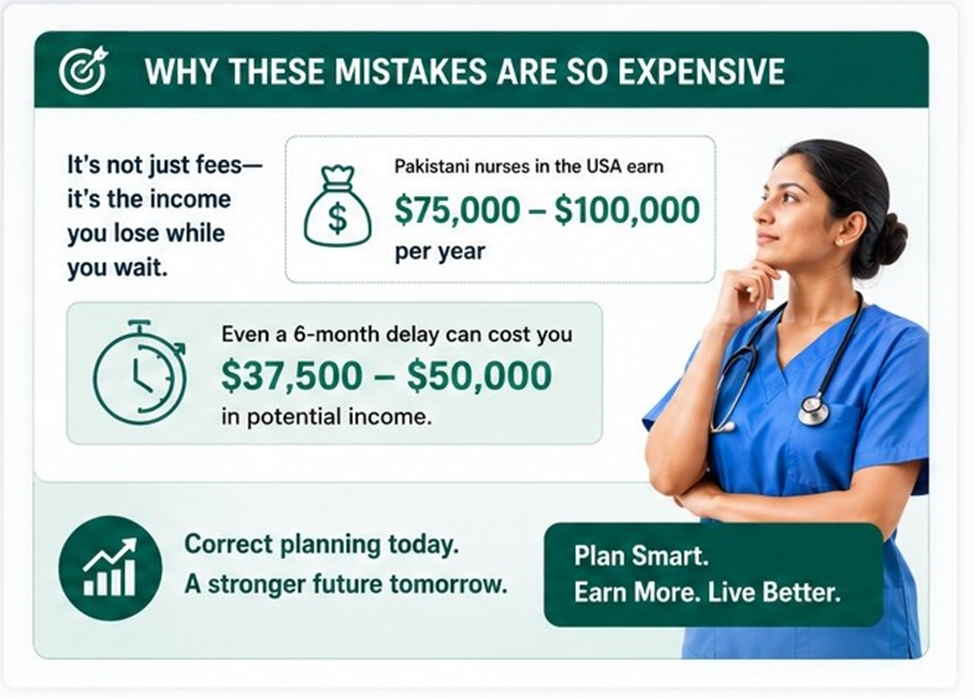
A Pakistani nurse working in a US hospital typically earns between USD 75,000 and USD 100,000 per year. When broken down, even a six-month delay in reaching the US can represent a loss of approximately USD 37,500 to USD 50,000 in potential income.
This is where most nurses underestimate the impact.
That is the real cost of these mistakes — not repeated exam fees, not additional paperwork, but the lost months of a US nursing salary that could have already started.
Now, let’s break down the five mistakes — and how to avoid each one.
Mistake 1: Choosing the wrong state board of nursing
What happens
A nurse selects a US state based on informal advice from a friend, a WhatsApp group, or a YouTube video.
The problem is that this advice is often:
- Outdated
- Based on someone else’s qualifications
- Not aligned with current state requirements
As a result, the nurse may unknowingly apply to a state that creates immediate complications such as:
She applies to a state that requires the CGFNS Certification Program for internationally educated nurses without realizing it. Her application stalls while she tries to complete an additional requirement she did not plan for. This leads to 3–4 months of delay before even receiving Authorization to Test (ATT).
Or she applies to a state where international processing times currently range from 6–8 months, while another state could have processed a similar application in 6–8 weeks.
Or she applies to a state that does not fully recognize her specific Pakistani nursing qualification, resulting in additional documentation requests and referral back to CGFNS.
Why this matters
The National Council of State Boards of Nursing (NCSBN) does not restrict international applicants, but each individual state sets its own licensing rules.
This means there is no single US licensing process.
There are 50 different nursing boards, and each one operates differently.
What is accepted in one state may not be accepted in another. Even within the same year, requirements can change significantly.
The general USRN pathway includes:
- Credential evaluation
- English language proficiency
- State board application
However, the way each of these steps is evaluated varies widely depending on the state.
Key differences between states include:
- Whether CGFNS Certification is required before NCLEX eligibility
- Processing time for international applications (highly variable)
- Documentation rules for Pakistani nursing qualifications
Additional practice or deficiency requirements (if applicable)
Historical verification relationships with Pakistani institutions
What should be done instead
State selection should never be based on informal advice or outdated experiences.
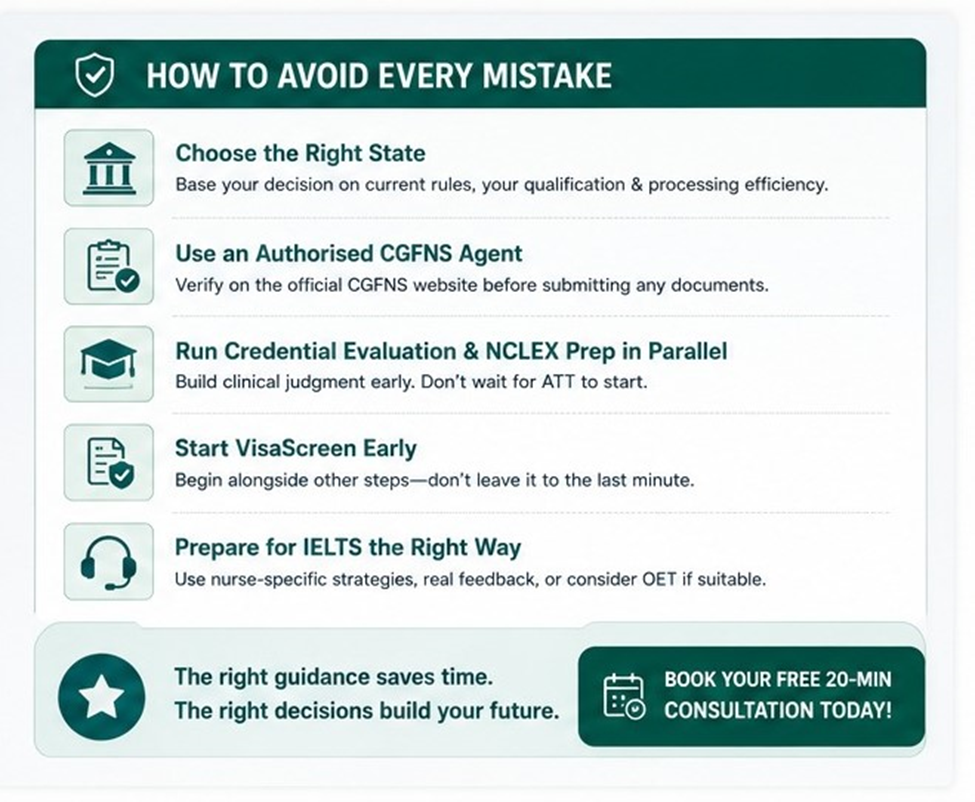
It should be based on:
- Current state board policies
- Your specific nursing qualification
- Processing efficiency for international nurses
- Document compatibility with your educational background
At Nurses Beyond Borders, state board selection is one of the first structured steps we review during consultation because it directly impacts every stage that follows.
We actively track which states are currently more efficient and suitable for Pakistani-trained nurses, and which may create unnecessary delays depending on your profile.
Approximate cost of this mistake
A wrong state selection can result in:
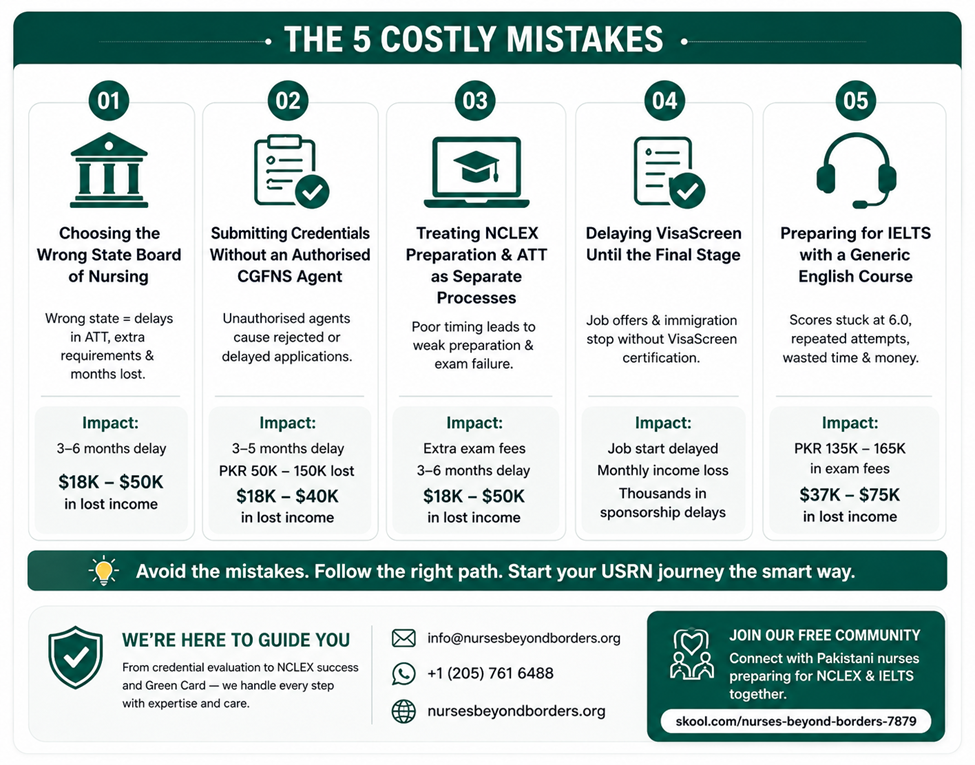
- 3–6 months of delay before ATT approval
- Loss of USD 18,000 to USD 50,000 in potential US income
- Additional time spent restarting or correcting applications
And all of this happens before the USRN journey has properly begun.
Mistake 2: Submitting credentials without an authorised CGFNS agent
What happens
A nurse works with a local consultancy that appears professional, charges a standard fee, and claims to handle CGFNS credential evaluation.
However, the consultancy is not an officially authorised CGFNS agent.
The submission is made, and at first everything appears normal. Then weeks pass. There is no clear progress. Communication becomes vague.
By then, 3–4 months have already been lost, along with the fees paid to the unauthorised agent.
Why this happens more often than expected
CGFNS International is the only recognized body responsible for verifying international nursing credentials for US licensure and immigration purposes.
Their reports are used by:
- US licensing boards
- Immigration authorities
- Employers and hospital systems
- Credentialing institutions
Because of this, CGFNS maintains a strict system of authorised agents who are permitted to submit applications on behalf of nurses.
An unauthorised agent cannot guarantee proper submission or processing.
The issue is that many consultancies:
- Do not clearly disclose their status
- Still accept documents and fees
- Submit applications incorrectly or incompletely
- Leave nurses unaware until delays appear
What CGFNS credential evaluation actually involves
The process is based on primary source verification, meaning CGFNS directly contacts:
- Your nursing college or university in Pakistan
- Your academic records and transcripts
- Your clinical training documentation
- Your Pakistan Nursing Council license
Each document must meet strict formatting and verification standards.
If anything is incorrect or incomplete, the application does not move forward — it pauses until corrected.
This is not a process that can be accelerated by third parties. It must be done correctly from the start.
How to verify authorised agents
Before working with any consultancy:
- Visit the official CGFNS website
- Check their authorised agent directory
- Confirm the organisation is listed
This takes less than a minute but can prevent months of delay.
If an agent is not listed, they should not be used for credential submission — regardless of claims or pricing.
Nurses Beyond Borders position
Nurses Beyond Borders is an officially authorised CGFNS agent, and all credential-related submissions are handled in accordance with CGFNS requirements to ensure proper processing and tracking from the beginning.
Approximate cost of this mistake
- 3–5 months of delay due to rejection or restart
- PKR 50,000–150,000 lost in agent fees
- Additional cost of reprocessing applications correctly
- Equivalent future income loss of USD 18,000 to USD 40,000
Mistake 3: Treating NCLEX Preparation and ATT Approval as Separate Processes
What happens
Many Pakistani nurses make one of two common mistakes when planning their NCLEX journey.
Scenario A: A nurse begins studying for NCLEX immediately after deciding to pursue the USRN pathway. She spends months reviewing content, watching videos, and answering practice questions. However, her credential evaluation has not been submitted, and she has not yet received her Authorization to Test (ATT). As a result, she invests significant time and energy into preparation without having a clear timeline for taking the exam.
Scenario B: Another nurse takes the opposite approach. She delays all NCLEX preparation until her ATT arrives. Once eligibility is confirmed and the exam date is approaching, she suddenly finds herself racing against time. With limited preparation and mounting pressure, she struggles to develop the clinical reasoning skills required to succeed on the exam.
Both approaches create unnecessary challenges.
Both can delay progress. And both are entirely avoidable.
The right approach
The most effective strategy is to run credential evaluation and NCLEX preparation simultaneously.
However, preparation does not mean immediately memorizing hundreds of medications or spending hours answering random practice questions.
Effective preparation starts with understanding how the NCLEX exam evaluates candidates.
Nurses who begin building this understanding early gain a significant advantage by the time their ATT arrives. Instead of starting from scratch, they already possess the foundation required to transition into focused exam preparation.
The goal is not simply to study harder.
The goal is to study smarter.
What NCLEX is really testing
One of the biggest misconceptions among internationally educated nurses is believing that NCLEX is primarily a knowledge-based examination.
It is not.
NCLEX is designed to assess clinical judgment, critical thinking, patient prioritization, and safe decision-making.
As a Computerized Adaptive Test (CAT), every question is selected based on your previous performance. The exam continuously evaluates your ability to apply nursing principles in real-world situations rather than simply recall facts.
In many cases, candidates understand the content but struggle with the decision-making framework required to answer questions correctly.
This is why nurses who focus only on memorization often find themselves disappointed despite spending months studying.
Clinical reasoning is a skill that develops gradually through structured practice and proper coaching.
It cannot be mastered in a few weeks.
Why timing matters
According to global NCLEX statistics, pass rates for internationally educated nurses remain significantly lower than those of domestic candidates.
Yet when nurses receive the right guidance, follow a structured methodology, and begin preparation at the appropriate stage, success rates increase dramatically.
The difference is rarely intelligence.
The difference is preparation strategy.
Nurses who understand the exam early are able to build the right habits, develop stronger clinical judgment, and approach questions with confidence when exam day arrives.
What successful preparation looks like
A well-structured NCLEX journey typically includes:
- Starting credential evaluation immediately
- Learning NCLEX methodology early in the process
- Understanding clinical judgment and patient prioritization concepts
- Building a study plan aligned with expected ATT timelines
- Avoiding excessive question-bank use before mastering core reasoning principles
- Transitioning into intensive practice once a solid foundation is established
By the time ATT approval arrives, preparation is already underway and momentum is established.
Understanding ATT timelines
Before scheduling the NCLEX examination, nurses must complete eligibility requirements and receive their Authorization to Test.
Processing times vary depending on:
- State Board of Nursing requirements
- Credential evaluation completion
- Documentation review timelines
- Application volume within the selected state
For some nurses, ATT approval may arrive within a few weeks. For others, it can take several months.
The nurses who benefit most from this waiting period are those who use the time strategically to strengthen clinical reasoning skills and prepare properly.
Approximate cost of this mistake
Poor NCLEX timing and preparation can lead to:
- Additional examination fees
- Pearson VUE rebooking costs
- Three to six months of extra preparation time
- Delayed employment opportunities
- Significant loss of future US nursing income
In many cases, the financial impact can range from USD 18,000 to USD 50,000 or more when delayed earnings are considered. The good news is that this mistake is completely preventable with the right planning and support.
Mistake 4: Delaying VisaScreen Until the Final Stage
What happens
This mistake often appears when a nurse believes she is approaching the finish line.
She completes her credential evaluation.
She passes NCLEX.
She secures employment through a US healthcare recruiter or hospital network.
Everything seems ready.
Then she discovers that her VisaScreen certification has not been completed.
Suddenly, the process stops.
Her employer cannot proceed with immigration or work authorization requirements until VisaScreen approval is finalized.
What should have been an exciting transition into US employment becomes another waiting period.
In some situations, start dates are delayed.
In more serious cases, employment arrangements may need to be adjusted while documentation is completed.
What VisaScreen actually is
VisaScreen is a federally required credential assessment program for internationally educated healthcare professionals seeking employment-based immigration to the United States.
For nurses, VisaScreen confirms three critical areas:
- Educational credentials
- English language proficiency (IELTS or OET)
- Professional nursing licensure
All three components must be reviewed, verified, and approved before a VisaScreen certificate can be issued. Without this certification, nurses cannot complete the immigration process required to work legally in the United States.
It is not optional.
It is not a step that can be skipped.
And it is not something that should be left until the end.
Why nurses postpone it
Many nurses naturally focus on the milestones that feel most important:
- Credential evaluation
- NCLEX preparation
- Passing NCLEX
- Job placement
Compared to these highly visible goals, VisaScreen often feels less urgent.
As a result, it gets pushed down the priority list.
Unfortunately, this creates problems later.
While nurses are celebrating exam success and job offers, VisaScreen processing may still require several months to complete.
This delay can directly impact employment timelines.
The right approach
VisaScreen should begin as early as possible—ideally alongside credential evaluation.
Many of the same documents used during credential evaluation are also required for VisaScreen processing.
Running both processes together creates efficiency and prevents unnecessary delays later.
When VisaScreen progresses in parallel with NCLEX preparation, IELTS completion, and credential evaluation, it is far more likely to be ready when employment opportunities arise.
How we approach VisaScreen
At Nurses Beyond Borders, VisaScreen planning begins early in the USRN journey.
Rather than treating it as a final administrative task, we integrate it into the overall roadmap from the beginning.
This ensures that every major requirement is moving forward simultaneously, reducing the risk of unexpected delays when nurses are ready for employment sponsorship.
Approximate cost of this mistake
The impact varies depending on individual circumstances.
Potential consequences include:
- Delayed job start dates
- Lost monthly income opportunities
- Employer sponsorship delays
- Extended immigration processing timelines
- Additional stress after years of preparation
For nurses approaching employment readiness, even a short delay can represent thousands of dollars in lost earnings and unnecessary uncertainty.
VisaScreen should never be the reason a qualified nurse has to wait longer than necessary to begin her career in the United States.
Mistake 5: Preparing for IELTS with a generic English course
What happens: A nurse’s IELTS score stays stuck at band 6.0 even after two or three attempts. She has already taken a general IELTS preparation course, possibly more than once. She practices speaking through apps, watches YouTube lessons, and reads academic articles to improve her English. Yet her score does not move, especially in writing, and she cannot understand why.
The real issue is simple: she is preparing for the wrong version of the test.
What IELTS is actually testing
This is the breakthrough most nurses discover too late. IELTS is not a general English ability test. It is an assessment of whether you can produce specific academic outputs using fixed structures that examiners are trained to score.
Academic Writing Task 1 has a defined reporting structure. Task 2 requires a clear argument pattern with logical progression. The Speaking test follows a predictable three-part format with recurring question types.
These are not random skills. They are structured, repeatable formats. And they are entirely separate from how well someone speaks English in real-life or clinical settings. This is why even strong communicators in hospitals can repeatedly fail IELTS writing until they are shown exactly what examiners are scoring.
A generic IELTS course is designed for a broad audience of international learners. It focuses on grammar, vocabulary, and general test familiarity. It does not teach nurse-specific writing demands, it does not break down exam structures in depth, and most importantly, it does not correct your actual performance in a meaningful, targeted way.
The feedback gap
The biggest limitation of generic IELTS preparation is not the teaching itself — it is the lack of precise feedback.
Automated scoring tools and generic instructors can tell you your band score, but they cannot tell you:
- which specific sentences are lowering your score
- why your coherence is weak in Task 2
- what structural change would immediately improve your writing band
- how examiners are interpreting your response line by line
This level of improvement requires a trained human examiner who understands both IELTS band descriptors and the communication patterns of nurses. Without that, candidates keep repeating the same mistakes without knowing what to fix.
This is the difference between repeating attempts and actually progressing.
The OET option
The OET (Occupational English Test) is designed specifically for healthcare professionals. It uses clinical scenarios, patient interactions, and medical communication rather than general academic topics.
For nurses who have attempted IELTS multiple times without progress, OET can be a more suitable alternative—not because it is easier, but because it evaluates language in a context closer to real nursing practice.
Importantly, OET is accepted for CGFNS VisaScreen certification. This means switching is not a compromise; for many nurses, it is a strategic correction in test alignment.
What nurse-specific IELTS preparation looks like
Effective IELTS preparation for nurses must be structured around nursing reality, not generic English learning.
In a nurse-specific system:
- every writing task is based on healthcare scenarios
- feedback is given line by line, not as a general comment
- examiners assess against official IELTS band descriptors
- speaking practice follows real test timing and format
- weaknesses are identified at sentence level, not just score level
This type of feedback is what allows candidates stuck at band 6.0 to actually break through, because it removes guesswork from the process.
At this stage, improvement is no longer about “more practice.” It is about targeted correction.
Approximate cost of this mistake
Each IELTS attempt costs approximately PKR 45,000 to PKR 55,000 in Pakistan (or equivalent in Kuwait, UAE, or Saudi Arabia). Three unsuccessful attempts can result in PKR 135,000 to PKR 165,000 in direct exam fees alone.
The larger cost is time. A 6–12 month delay in progressing through the USRN pathway directly impacts earning potential, which can translate into USD 37,000 to USD 75,000 in delayed US nursing income.
The compound effect: when multiple mistakes happen together
Individually, these mistakes are costly. Together, they create long delays that compound across the entire USRN journey.
A wrong state board delays ATT. An unauthorised agent stalls credential evaluation. Poor NCLEX timing weakens exam performance. Delayed VisaScreen blocks employment. And a stuck IELTS score prevents VisaScreen completion altogether.
Each delay pushes the entire timeline further out and increases total financial loss.
Most nurses who feel “stuck for years” are not facing one issue — they are dealing with several overlapping mistakes at the same time.
The solution is not more effort. It is correct sequencing, correct guidance, and correct structure from the start.
How to start correctly
The most important step at any stage of the USRN journey is clarity—knowing exactly where you stand and what needs to happen next based on your specific situation.
Not general advice. Not assumptions based on others’ experiences. A clear, structured assessment based on your own qualifications, progress, and timeline.
That is what a guided consultation is designed to provide.
In a focused review, you should be able to:
- identify whether IELTS is the correct path or if OET is better suited
- understand what is blocking your current score progression
- align your preparation method with exam requirements
- remove wasted effort and focus only on high-impact changes
What Nurses Beyond Borders offers for IELTS and overall preparation
For IELTS preparation, the focus is on correcting actual performance issues—not just practicing more questions. This includes structured feedback on writing, speaking evaluation against IELTS band descriptors, and training designed specifically for nurses in clinical communication contexts.
For candidates who are better suited to OET, preparation is aligned with healthcare-based assessment formats.
The goal is not more study time. It is measurable improvement in score performance through targeted correction.
Frequently asked questions
Is it too late to fix a low IELTS score?
No. Most nurses who are stuck at band 6.0 improve after switching to structured, feedback-based preparation. The issue is usually method, not ability.
Should I switch to OET if IELTS is not improving?
It depends on your pattern. If multiple IELTS attempts show no progress, OET can be a more appropriate alternative because it uses clinical context instead of academic topics.
What is the fastest way to improve IELTS writing?
Not more practice tests. The fastest improvement comes from line-by-line feedback that identifies structural and coherence issues and corrects them directly.
The bottom line
IELTS is not difficult because of language. It becomes difficult when preparation is not aligned with how the exam is actually scored.
Most repeated failures come from generic preparation methods that do not address exam structure or provide meaningful feedback.
Once the test format, scoring system, and feedback loop are correctly understood, progress becomes significantly more predictable.
The difference is not effort. It is precision.
Take the next step
Book a free 20-minute consultation with Nurses Beyond Borders.
We will review your current position in the USRN journey, identify which of the mistakes discussed are affecting your progress—whether you are just starting or already partway through—and map out a clear, step-by-step plan tailored to your situation.
No sales pressure. No obligation. Just a structured understanding of where you are and what needs to happen next.
info@nursesbeyondborders.org
WhatsApp: +1 (205) 761 6488
nursesbeyondborders.org
Or join our free Skool community where Pakistani nurses from Pakistan, UAE, Kuwait, and Saudi Arabia are preparing for NCLEX and IELTS together, with access to live sessions, recorded guidance, and direct support from coaches.
skool.com/nurses-beyond-borders-7879
About Nurses Beyond Borders
Nurses Beyond Borders (NBB Global LLC) is headquartered in Hoover, Alabama, USA. We are an officially authorised CGFNS agent, supporting internationally educated nurses through verified credential evaluation and structured USRN preparation.
We maintain a 92% NCLEX pass rate among our coached nurses and have supported over 1,000 Pakistani nurses through different stages of the USRN pathway, from initial planning to exam success and placement readiness.
Related posts
● Pakistani nurses in Kuwait: complete guide to moving to the USA
● CGFNS credential evaluation explained for Pakistani nurses — a complete guide
● Why Pakistani nurses fail NCLEX — and it has nothing to do with intelligence
● How to move your IELTS writing score from 6.0 to 7.0
● EB-3 Green Card for Pakistani nurses — not a lottery, a process